
Preparing for an Occupation
Local leaders need to assume ICE will ramp up everywhere and plan accordingly.
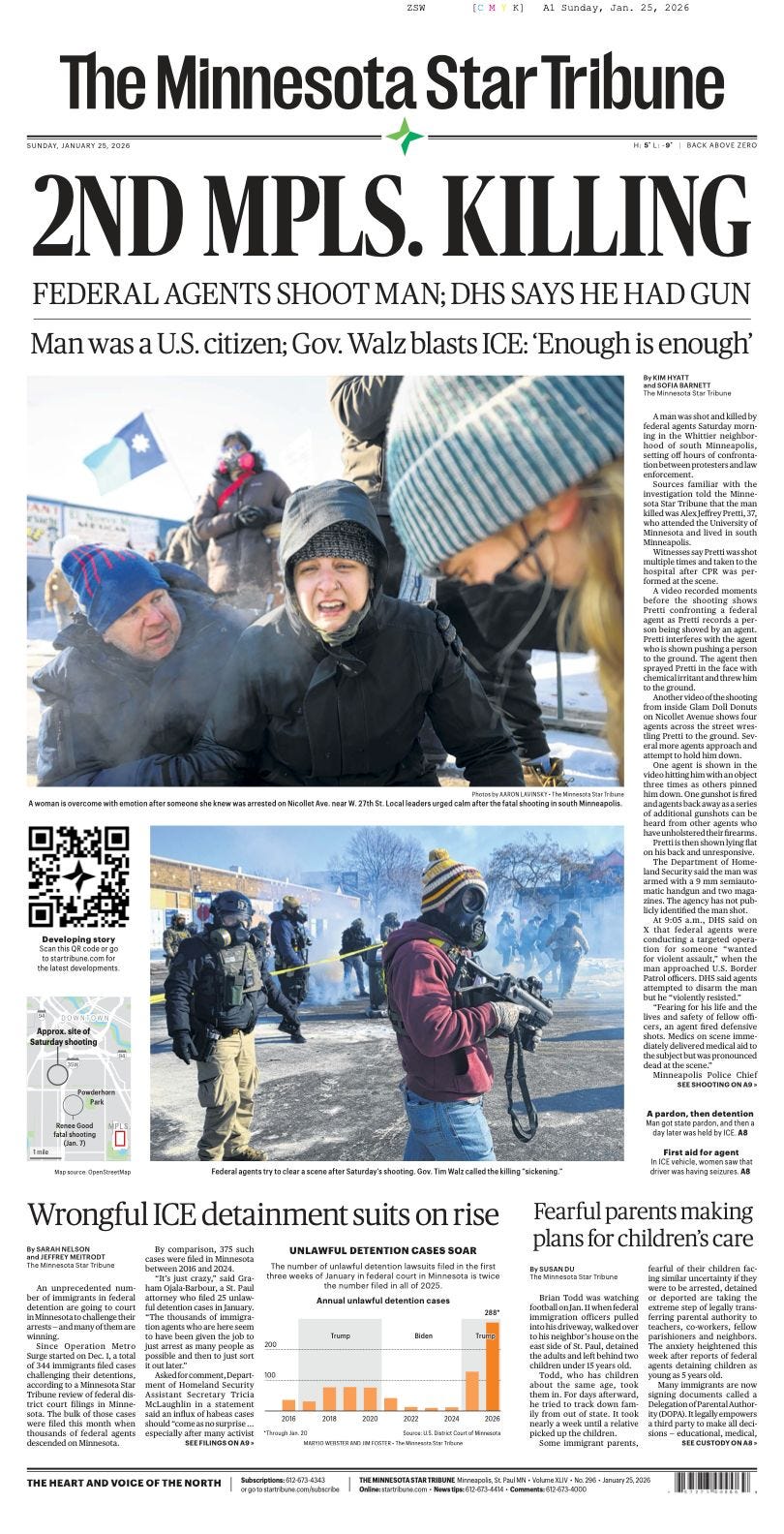
The tragic and disturbing scenes unfolding in Minneapolis should frighten all of us. Through ICE, Trump has assembled a paramilitary force that can terrorize residents and kill with impunity. Masked agents shatter car windows, break down doors and drag people out of their homes and workplaces. They arrest first and ask questions later. No one is spared, not even U.S. citizens. M. Gessen called the campaign “state terror” in her New York Times column today.
As Minneapolis Mayor Jacob Frey said, “It should alarm every American because if it can happen here, it can happen anywhere.”
The siege of Minneapolis poses urgent questions for local officials across the country. How do you prepare for an occupation?
Is there an overall plan if ICE surges in Monroe County?
Large-scale federal enforcement operations do not leave time for ad-hoc decision-making. Monroe County needs a clear, pre-established plan that defines roles and responsibilities across local law enforcement, county agencies, emergency services, and the district attorney’s office before federal agents arrive. Crucially, that plan must start from a clear premise: local government is not an extension of federal immigration enforcement. Without an explicit framework that prioritizes non-cooperation, authority fragments, accountability evaporates, and harm becomes more likely.
What is the role of local police — and what is explicitly off-limits?
Each department needs clear, written policies for different scenarios. For example: what happens when residents call 911 terrified that masked agents are breaking down a neighbor’s door? Local police may be needed to address genuine public safety concerns — traffic, medical emergencies, crowd safety. But sanctuary policies that prohibit direct cooperation often still permit “support” roles — crowd control, perimeter security, traffic management — that functionally enable ICE operations. Local officials should be explicit about what police will not do, not just what they might do, and how those limits will be enforced in real time.
If a federal agent seriously injures or kills someone, who controls the scene — and who asserts jurisdiction?
Will local law enforcement preserve the scene as they would any other homicide, securing evidence and witnesses? Or will federal agencies control access, remove evidence, and dictate the investigative timeline? If a federal agent commits an act that would otherwise be charged under state law, will the district attorney assert independent jurisdiction — or defer automatically to federal authorities?
What protections are in place for peaceful protesters?
What specific instructions are given to local police to protect lawful assembly — particularly if federal agents use aggressive tactics that escalate tension? Police must understand that protecting protesters from harm is not the same as protecting federal operations from protest.
What legal and medical support systems are pre-positioned?
Are emergency medical services prepared for injuries linked to enforcement actions? Are civil rights monitors and legal observers able to operate without interference? Or will the city improvise after arrests are made and people are hurt?
Will local leaders at least try to protect us?
I worry there may never be a real plan to prepare for an ICE surge. You can’t plan around an occupation if you can’t agree whether the occupation itself is legitimate.
Many of our local leaders have been reluctant to criticize ICE or have remained silent altogether.1 Some appear to be in denial about what’s happening; others seem afraid of being labeled anti–law enforcement. We don’t even know which police agencies are collaborating with ICE. New York law places some limits on cooperation, but police can still call Border Patrol if they suspect someone is undocumented — and they do.
A plan presumes agreement on what actions are acceptable. I don’t believe that agreement exists among our local leaders — all Democrats — when it comes to ICE’s presence and tactics. And without that shared understanding, any “plan” will collapse the moment federal agents arrive.
It’s time for local leaders to pick a side and make a plan. Because as Radley Balko warns, “We need to be clear about what we’re facing. This is no longer a conversation about law enforcement or immigration policy. This is about authoritarianism.”
Sheriff Todd Baxter has said nothing. County Executive Adam Bello’s first statement on ICE was a short paragraph after the killing of Renee Good.
Any suggestions for local citizens? A list of actions? Is there a list of numbers for us to call and ask about the organization of a plan? How can we organize and get this plan together? It’s frustrating to see all these separate local action groups and no one working together .
Minneapolis is unique in having politicians who support community-based nonviolent direct action, as we've all seen in the news.
Rochester is not a version of anything, regarding such matters. The history of activism displays no protection, patience or tolerance of street activism, going all the way back to FIGHT's campaign to get Blacks employed at Kodak. There is a substantial core of street activists, and some community-wide organizing is on-going in several groups, but little coordination between groups. However, the Jan. 8 street protest outside Rochacha BCP headquarters was well done, experienced communications, marshalling, sustaining coffee and food allowed long hours in a pretty chilly evening.
I think we know what we could be facing. And no amount of organizing and training is too much! I think Rachael's writing here is a good wake-up call for anyone who hasn't been following the news. And a bit of stringent exhortation might pull us all together.
Kudos!