
Notes on the Monroe County Draft Comprehensive Plan
Monroe County's first comprehensive plan in 40 years barely mentions the county's biggest job.
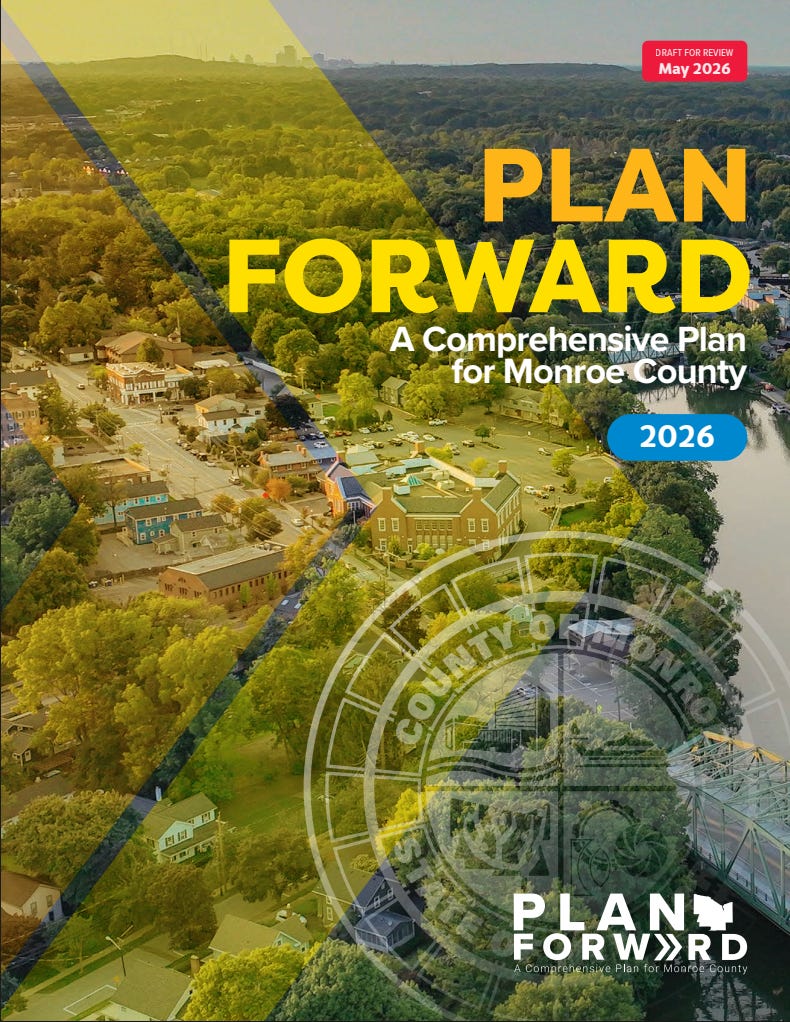
Monroe County released a draft comprehensive plan this month, the first in 40 years. These plans ask what kind of community are we trying to become, and how are we going to get there? Comprehensive plans help governments guide decision-making.
Here are my notes.
The diagnosis is stronger than the prescription.
The strongest parts of Monroe County’s draft comprehensive plan are the sections that profile Monroe County.
The document paints a detailed and often sobering portrait of the region: sprawl continuing even as household growth stagnates; climate impacts already worsening; an economy increasingly dependent on low-wage hospitality jobs; major gaps in childcare, transportation, and power infrastructure, difficulty retaining college graduates despite the region’s educational assets, and a persistent mismatch between available jobs and workforce preparation.
The plan also contains genuinely useful observations about changing household structures, the need for flexible housing types, the risks posed by climate change, and the economic importance of advanced manufacturing and semiconductor supply chains. In many places, the diagnosis is thoughtful, data-rich, and candid about Monroe County’s vulnerabilities.
The problem is what follows. Many of the strategies require action by parties the county cannot direct — municipalities that control their own zoning, businesses that make their own investment decisions, state and federal agencies that control most of the funding. Onondaga County’s comparable plan recognizes this challenge and addresses it. The county positions itself as convener and technical assistance provider, then designs its recommendations around that role. Monroe’s plan tends to gloss over those constraints. The implementation matrix assigns responsibility across county government, municipalities, businesses, and individuals — but without timelines or named leads, it's a starting point, not a roadmap.
The plan is way too light on poverty.
The plan is notably thin on poverty given the scale of Monroe County’s responsibility for administering the social safety net.
The plan documents the correlation between poverty and life expectancy, the racial geography of concentrated poverty, the connection between historic land use decisions and today’s disparities. It acknowledges that redlining and suburban job sprawl produced the segregated, unequal Monroe County we have now.
Human Services — the department that administers SNAP, Medicaid, and Temporary Assistance — represents nearly 39% of county spending, more than $600 million. It is the largest county department. But by placing poverty primarily in the public health chapter, the plan effectively sidesteps the department most responsible for administering the social safety net.
The plan briefly notes that demand for county social services is expected to rise as state and federal support declines — and then moves on. There is no framework for improving access to benefits, reducing administrative barriers, or measuring whether residents are actually receiving the help they qualify for. Instead, the poverty response defaults to outreach initiatives, healthcare programs, workforce pipelines, and ARPA-funded efforts already underway.1
The housing discussion all but ignores the county’s poorest residents. The plan frames the affordability crisis primarily as a workforce recruitment challenge — insufficient supply of units for households earning 60-80% of Area Median Income, the so-called “missing middle.” But there is no rent burden analysis. No eviction data. No discussion of housing vouchers, public housing, or the gap between what deeply low-income residents can afford and what the market provides. The word “homeless” appears one time in the entire document.
The result is a plan that clearly understands many of Monroe County’s underlying social problems but says surprisingly little about what the county itself intends to do differently in response.2
The freight section is a tell.
One reason the freight section stands out is that it is one of the few places where the plan reads less like aspiration and more like institutional intent. The county has been building toward a regional multimodal facility for years — a $1 million study was approved in 2022. The language here suggests the county is ready to move. If this is where the county is headed, residents and legislators deserve a full analysis before a shovel goes in the ground. The county has never released the study paid for by taxpayers, despite requests from legislators.
Vision Zero!
The plan calls on Monroe County to adopt Vision Zero as a strategic framework. Vision Zero treats traffic deaths as preventable, not inevitable. It requires redesigning roads, managing speeds, and aligning enforcement, planning, and infrastructure to end all fatalities. Rochester has a Vision Zero plan already.
I’m thrilled to see Vision Zero in the plan, but the one thing I’d push for in public comment is to define what adoption means. A resolution? A county plan with measurable targets? A road design standard applied to county-owned roads? The implementation matrix leaves that open.
While I have concerns with the draft, this is an important government and community exercise that forces us to think about our past, present and future. I am grateful to the leadership of the county executive in developing this much-needed plan, as well as the staff that put this together. You can read the draft here and learn how to submit comments here.
The omission is notable because in a report I published in 2025, I documented that Monroe County denied more than 22,000 public assistance applications in 2024 — an 81.5% denial rate that ranked among the worst in New York State and the highest among peer urban counties. Monroe County also closes cases for procedural noncompliance at rates higher than Erie and Onondaga counties. Meanwhile, the county budget includes a “cost avoidance” metric tied in part to case closures and reduced caseloads. While case closures are not inherently improper, emphasizing them as fiscal outcomes sits uneasily beside the county’s stated anti-poverty goals.
Post-publication footnote: Someone asked if the plan incorporates RASE Commission recommendations. There is some overlap on housing, transportaton, health and other challenges, but RASE is far more specific in its policy recommendations. Importantly, the plan does not mention RASE once.
this sounds from your description, to be more of a survey of the landscape but not a PLAN. If the plan glosses over challenges, doesn't provide for who is leading and some timelines, how is this a PLAN? If implementation is not even given an outline, isn't this more of a situation acknowledgement ? I'll go read the document now. :)