
Let's Talk About STAMP
A big proposed data center relies on our water and electric grid.
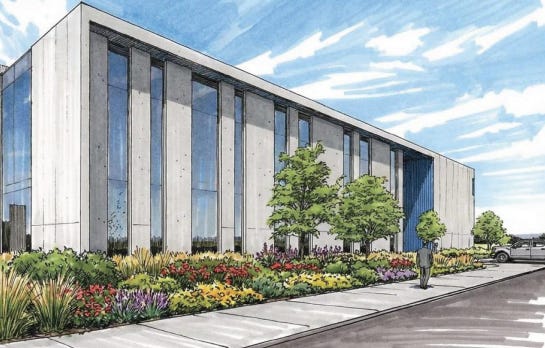
Update: Governor Kathy Hochul announced a one-year morratorium on data centers that have not obtained DEC permits. That would appear to include this project, but advocates are not sure yet.- RB 7/14/2026
You’ve probably seen the headlines about a massive data center1 proposed for Genesee County. You may have wondered why Monroe County legislators would care. Here’s why, and here’s what my colleagues and I are doing about it.
What is STAMP
STAMP stands for the WNY Science & Technology Advanced Manufacturing Park. It’s a roughly 1,250-acre megasite in the Town of Alabama, in Genesee County, about 35 miles west of Rochester. The Genesee County Economic Development Center (GCEDC) owns and markets the site. Despite years of marketing and tens of millions of dollars in taxpayer investment, STAMP has one tenant, Edwards Vacuum.
A second tenant would be a data center developed by STREAM U.S. Data Centers, LLC. It would have an electric load of 500 megawatts, about 80% of the power at the entire STAMP complex. For scale, it could power 400,000 homes, more households than exist in all of Monroe County.
Who’s paying
STREAM is planning to spend $19.4 billion to build the data center, and would receive $1.46 billion in tax breaks for 125 permanent jobs with an average salary of $88,000. Investigative Post calculated that out to $11.7 million per permanent job, which may be the most expensive cost-per-job subsidy deal in U.S. history.
Those subsidies come from mortgage and sales tax dollars not paid to local schools and towns. Among the entities losing money is the struggling Rochester Genesee Regional Transportation Authority, which would experience a one-time loss of $6.2 million from revenue the project would otherwise have to pay.
STREAM has agreed to pay $50 million toward finishing the 600-megawatt substation already under construction at STAMP. The state has invested $100 million into getting STAMP shovel-ready for companies.
GCEDC earns fees from the project, potentially more than $140 million, so it has incentive to approve the tax breaks and environmental clearance.
Genesee County officials argue towns and school districts would get more revenue over time — $285 million over 30 years — from the data center than one-time revenue hit. And they hope the fees pay for the county’s badly-needed water infrastructure upgrades.
Why does Monroe County care
STAMP sits in Genesee County. So why am I, a Monroe County legislator, writing about it? Because the project relies on our electric grid and our water supply.
Water. The Monroe County Water Authority (MCWA) sells wholesale water to Genesee County. A 2001 phase brought 2.5 million gallons a day of Lake Ontario water into the county. A second phase, now under construction and due to finish this December, adds another 2.5 million gallons a day. Genesee County, in turn, committed 200,000 gallons a day of its supply to the STAMP site under a 2017 agreement with GCEDC.
STREAM has estimated the data center’s own water needs at approximately 20,000 gallons a day. That’s not a huge consumption rate (consider the fact Edwards Vacuum uses 30,000 gallons a day) because this data center will not be cooled by water. The tradeoff is that it will use enormous amounts of power, which will be discussed below.
But the water question is still relevant for a couple reasons. GCEDC says data center revenue would help fund badly needed water infrastructure in Genesee County, bringing up to 10 million gallons a day of Lake Ontario water through MCWA. Critics argue that it’s wrong to hold the county hostage to what they deem to be a harmful project. They are worried STAMP could eventually need much more than 200,000 gallons a day, as the complex claims it can handle 1 million gallons a day. That raises real questions about the ramifications for everyone with a stake in this — residents, farms, local businesses, and STAMP itself. Yes, Lake Ontario is plentiful. Let's find out what that actually means for all of them.
Another issue is whether Monroe County should be supplying water to a project opposed by so many residents, environmental organizations, and the Tonawanda Seneca Nation.2
Power. In order for power to get to STAMP, it has to run through RG&E’s system. RG&E taps into that regional power line, owned by the New York Power Authority, at a substation called Station 255 in Monroe County, the same connection that gives our own grid backup power and reliability. In May, RG&E agreed to install new equipment there to stabilize voltage on that line. Without it, adding a load this big degrades voltage for everyone who depends on it, not just STAMP. GCEDC is footing that $4.3 million bill. (See page 9.)
Station 255 is in Henrietta. It’s the same substation where RG&E, Monroe County, and state officials recently announced a $4.7 million grant, to add capacity because that area of the county had run out. The shortage had already forced RG&E to turn away local projects, including nearly 1,000 units of affordable, senior, and family housing.
So the same station is getting two capital investments at the same time: one meant to unlock housing and jobs in Monroe County, and one meant to support a 500-megawatt data center 35 miles away.
This leads to an obvious question of how this project impacts ratepayers and future capacity.
The Investigative Post quoted experts saying that a 500-megawatt load could raise electricity bills for both residential and commercial customers. Jessica Azulay, of the Alliance for a Green Economy, said a load this size could force the state to bring more expensive generators online just to meet peak demand. Although NYISO approved a 600-megawatt capacity ceiling for the STAMP site, it has separately said it will still study this specific data center's impact on the grid, and has warned that the state is running out of capacity statewide.
A memo from GCEDC’s outside counsel, Phillips Lytle LLP, claims the data center’s steady, round-the-clock power draw would actually help ratepayers by absorbing surplus electricity and contributing to fixed grid costs through its own bill. Independent grid experts and GCEDC’s hired consultants are telling two different stories, and residents deserve to know which one is right.
What we’re asking
Last week, six of us on the Democratic Caucus of the Monroe County Legislature sent letters to RG&E and to MCWA requesting briefings.
You can read the letters here:
I cannot sit here and tell you the impact on Monroe County residents from this project. But we deserve to know. I’ll keep you posted if they agree to have this conversation.
Someone on Facebook asked what is a data center. My answer: A data center is basically a giant warehouse full of computer servers, the machines that store data and run things like websites, streaming, online banking, and AI tools like ChatGPT. Every time you save a photo to the cloud or ask an AI a question, it's a data center somewhere doing the work. This one would be massive.
Now seems like a good time to point out a majority of my Democratic colleagues, at the behest of the county executive, refuse to appoint a Democratic majority on the MCWA board.
A couple thoughts:
- Electricity
In other parts of the country, data centers are generating their own power rather than using power from the grid. This can be a bad option, but it doesn't have to be. One option is to use hydrogen fuel cells to supply the electricity, which by happy coincidence Rochester already has local expertise in this area. PlugPower, which has local facilities, has recently released a webinar on this topic.
https://www.plugpower.com/webinar-reducing-grid-strain-and-supporting-operational-growth-with-fuel-cells/
It's no surprise that STREAM doesn't want to investing it's own money in power generation when RG&E will happily sell them the electricity, but that's not a good reason to burden rate payers with extra costs.
- Water
As with electricity, STREAM obviously doesn't want to invest it's own money to provide water when the Monroe County Water Authority will sell them water. But it's interesting that STREAM doesn't plan to use water to cool the servers in this proposed facility. I'm going to speculate that they are not going to use water either because 1) MCWA can't provide them with sufficient quantities of water, and / or 2) the water that MCWA can provide isn't cold enough.
Those of us with good memories will recall that there have been previous efforts to use Lake Ontario water to provide cooling. Xerox investigated this back in the 1990's, and the Town of Webster initiated another study in the early 2010's. I don't know why this was never implemented, but I will guess that a curious member of the county legislature could find out. Those studies were focused on using lake water to chill (air condition) facilities, but a similar concept can be used to chill computer servers. Here's an article about the more recent effort.
https://www.democratandchronicle.com/story/news/2014/06/30/webster-lake-ontario-cold-industry/11798879/
Assuming that the barrier to using Lake Ontario water to chill a data center located at STAMP is supply and/or water temperature, one must wonder if STAMP is the wrong location for STREAM's data center. Perhaps Webster or another location closer to Lake Ontario would be a better choice.
AI has the potential to ease suffering and cure disease and make life beautiful and feed and educate the vulnerable. But we all know what will happen: The fascists will steal our faces. And our privacy. And our freedom. And our money. And our homes. And our resources. And our climate. They will bribe our town and city leaders. And our leaders and our media will lie about it. And the WHAM listeners and the FOX watchers in their red hats will believe the lies because they can make a stupid movie with their face in it on their phone. We don’t need data centers. We don’t need more entertainment. We need a future. We are so fucked.